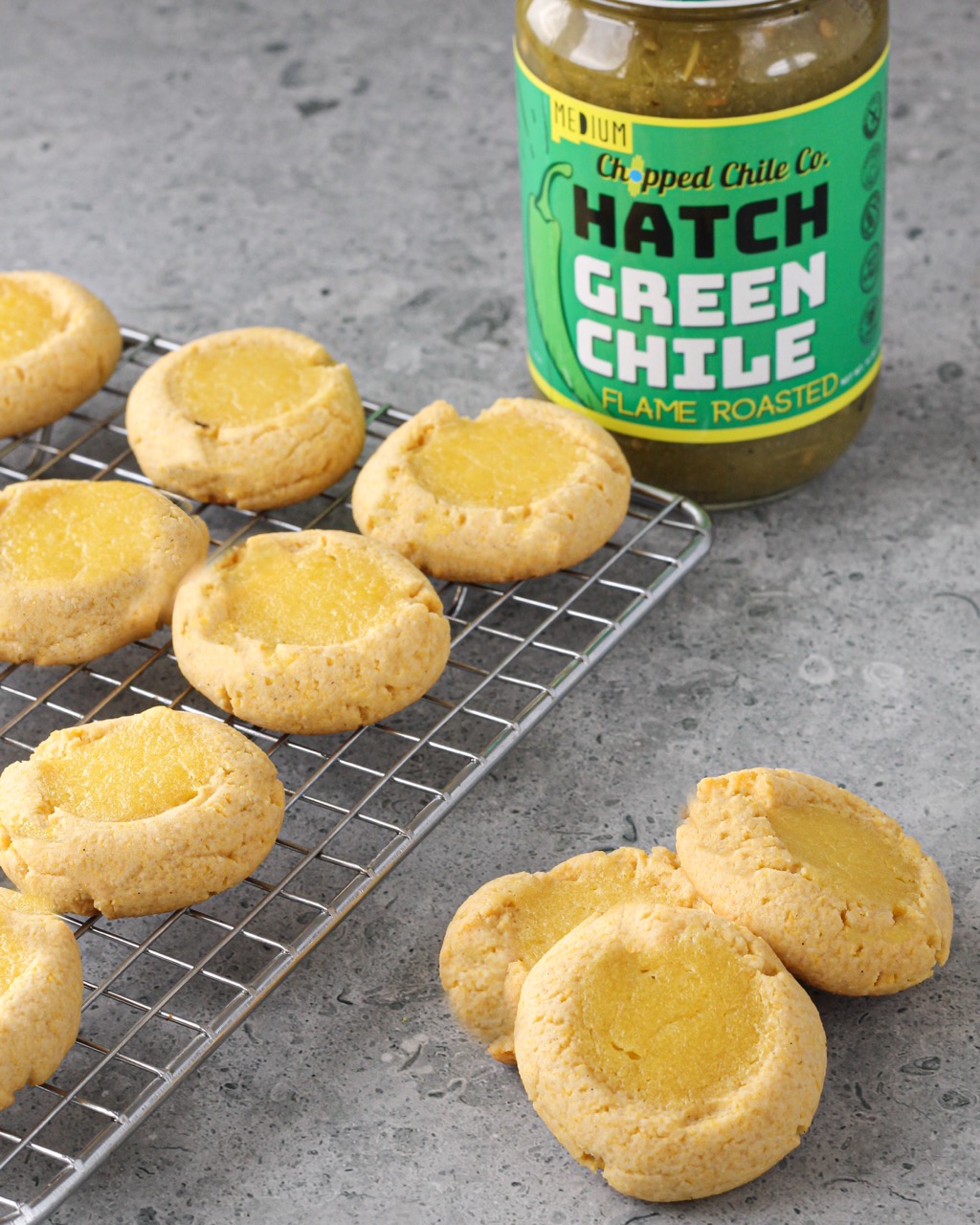

The curd is the recipe. The cookie is the vehicle. Cornmeal thumbprints are straightforward, but a mango curd with green chile in it is a technique piece, and it is where this succeeds or fails.
Two things determine whether it works: the curd has to cook gently over a double boiler, because direct heat scrambles the eggs, and it has to chill for two hours before it is thick enough to sit in a cookie. That chill is most of the three hour total time, so start the curd first.
Jump to
Making curd without scrambling it
Curd is eggs thickened by heat, which means it sits one step away from sweet scrambled eggs at all times. The double boiler is what stands between you and that.
- The bowl must not touch the water. An inch or two of water in the pan, the bowl sitting above it. Contact with the water means direct heat, and direct heat means curdling.
- Keep the water at a low simmer, not a boil. Bring it up, then turn it down before the bowl goes on.
- Stir frequently, not constantly. Every twenty seconds or so, scraping the sides where it sets first.
- Ten to fifteen minutes is normal. It is done when it coats the back of a spoon and a finger drawn through leaves a clean line.
- Butter goes in off the heat, cold and a few pieces at a time. Cold butter drops the temperature and stops the cooking, which is why the recipe specifies it.
- Strain it. Even a perfect curd has a little cooked egg in it, and thirty seconds with a sieve is the difference between silky and slightly grainy.
If it does curdle, a stick blender can sometimes rescue it. Straining catches the rest.
Chile in a sweet curd
One tablespoon of roasted green chile into half a cup of mango purée is a light hand, and deliberately so. The curd is sweet, tart and rich all at once, and the chile is there to give it a finish rather than to make it a spicy dessert.
It works for the same reason chile works with chocolate: capsaicin is a heat sensation rather than a flavor, so it arrives after the sweetness rather than competing with it. Mango and chile is also a long-established pairing, and this is that pairing with the chile roasted rather than raw.
The recipe note suggests red chile instead for a milder, sweeter version, and that is worth trying. Red is the same pod left to ripen, so it is sweeter and earthier, and it sits closer to the mango.
Blending the chile into the purée before it goes in the bowl gives even heat. Leaving it chopped gives you occasional warm bites. Both are fine, and the blended version is the safer choice for a cookie you are handing round.
The cornmeal cookie
Cornmeal does two useful things here. It gives a slightly sandy, short texture that holds a well without slumping, and it brings a mild corn sweetness that sits well under a tropical curd.
Honey and brown sugar rather than white sugar keep the dough soft and the flavor rounded. The dough should be soft but scoopable, roughly a tablespoon a cookie.
Press the wells with the back of a teaspoon, not your thumb. A spoon gives you an even, round, deep well. A thumb gives you a shallow uneven one that the curd runs out of.
The curd goes in before baking, not after. Twelve to fifteen minutes sets it in place and the cookie browns underneath.
Storing both parts
The curd keeps about a week refrigerated in a covered container, and the recipe makes more than the cookies need. It is very good on toast, scones or yogurt, which is the intended use for the leftovers.
Curd freezes for a couple of months. Thaw it in the fridge and whisk it smooth.
Filled cookies keep 3 to 4 days in an airtight container at room temperature. Because the filling is egg based, refrigerate them if your kitchen is warm.
The dough freezes as scooped balls. Bake from frozen with a couple of minutes added, pressing the wells as soon as they come out of the freezer rather than while frozen solid.
What else to make
If the chile-in-dessert idea landed, green chile chocolate chip cookies are the simpler version of the same argument, and red chile brownies the richer one.
The chile is 16 oz jars of flame roasted Hatch green chile, Medium or Hot, four ingredients: Hatch chile, salt, garlic, lime juice. A tablespoon here means a jar lasts a very long time, so green chile stew or queso is where the rest of it goes. The recipe archive is free.
Common questions
Why does curd need a double boiler?
Because it is thickened egg, and direct heat scrambles it. The bowl should sit above the water without touching it, over a low simmer rather than a boil.
How do I know when curd is done?
It coats the back of a spoon, and a finger drawn across that spoon leaves a clean line. Ten to fifteen minutes is normal.
Why is the butter added cold and off the heat?
Cold butter drops the temperature and stops the curd cooking further, and adding it gradually keeps the emulsion smooth.
Does the curd need to chill before filling the cookies?
Yes, about two hours. Warm curd is too loose to sit in a thumbprint well.
How spicy is the curd?
Barely. One tablespoon of chile into half a cup of mango purée gives a warm finish rather than heat. Red chile makes it milder and sweeter still.
Can I make the curd ahead?
Yes, up to a week refrigerated or a couple of months frozen. The recipe deliberately makes more than the cookies need.
Why press the wells with a spoon instead of a thumb?
A spoon makes an even, deep, round well. A thumb makes a shallow uneven one that the curd escapes from during baking.
The short version
Make the curd first, over a double boiler, off the heat for the butter, strained, then two hours in the fridge. Scoop the dough, press the wells with a spoon, fill before baking, twelve to fifteen minutes. The leftover curd is the best part and belongs on toast.